Monday, August 16, 2010

These Are My Roommates


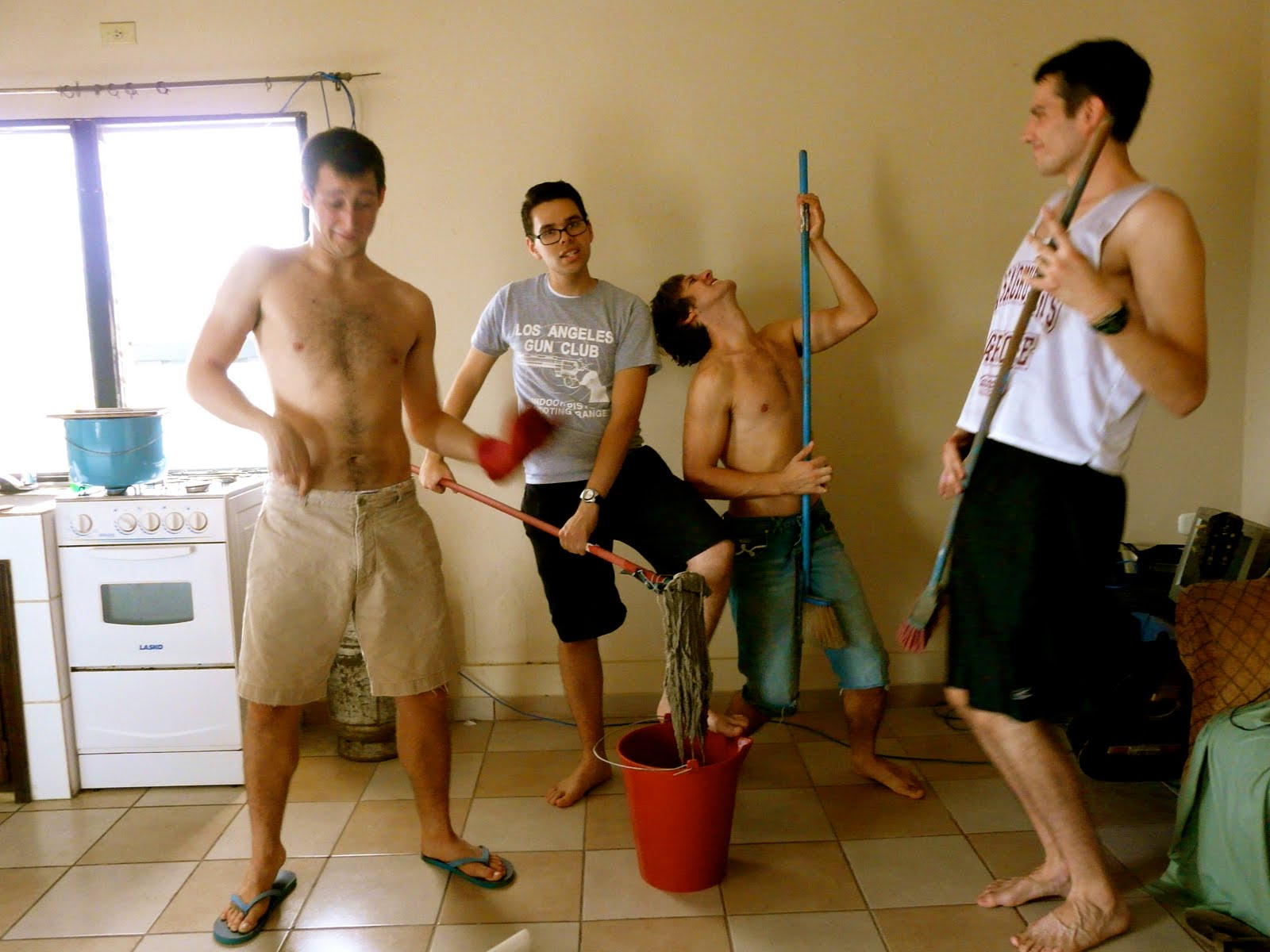
*From left to right: Josh, Julio (aka "Jules"), Me, and Matt*


Welcome to "Man-partment." Population: 4. The rules are simple here: Clean up after yourself and keep it real. Keep it real means if something bothers you, just let 'er rip. No reason to let it fester. Keep it real.

Introducing the team: 

Josh (far left) hails from Atlanta, Georgia, but unfortunately he doesn't sound like it. His interests include debating Latin American politics, "slacklining" (tying a rope between two trees and tightrope walking on it), showing off his mastery of fancy economics terms, and eating baleadas like its his job. He insists that his students call him "Don Josh" as opposed to "Mr. Josh." Some of the true Dons in this town have taken offense and retort, "this man has no land, he has no wives, and doesn't even have an illegitemate child... who does he think he is?"

Julio "aka Giulio", aka "Jules" - is a physicist from Caltech. He grew up in Venezuela and speaks Spanish at a level that all of us envy.  In the first day we all went around and said why we were here, all trying to develop a more heartfelt answer than the person before us and Julio said, "I wanted to take a year off school, and this would look good on med school apps."  All right, keepin it real, we thought. This answer wasn't truly representative of Julio, however, as he works in the "Learning Center" with the toughest of kids and has started tutoring the little ones before school has even started. Jules is a self-diagnosed "nerd" and is often the punchline of our jokes: a role that he accepts with grace. We often play a drinking game in which we have to choose a category and go around a circle trying to think of something in that category. The usual topics are types of cars, hair products etc., but our favorite category is "things that jules would do with his friends at Caltech."

Me-  If you don't know me, then what are you doin' reading this blog.... creepy.

You can't tell by this picture but Matt is actually 6'6. He is the largest man I have ever called my friend. I am still trying to get used to how tall he is. It is really fun to walk through town, though, and watch people look at him and gasp. Also, he is really great to walk with down the sketchy streets of Cofradia at night. Matt comes from Boston (also lacking an accent) and is one of two teachers down here who has a teaching credential and actually has a goddamned clue of what he is doing. He is a big teddy bear and gives nice hugs. He has also been sick nonstop for the past month. He finally got a shot in his butt last night from the team doctor who lives across the street and seems to be doing improving.

Man-partment.

Sunday, August 15, 2010

Comida? Ahora? No...


The volunteer teachers spent this past weekened at the beach, a nice final hurrah before school goes into full swing next Monday. We chose Triunfo de la Cruz, a small Garifuna town on the Caribbean coast of Honduras where there is nothing but beach, cabanas and reggae. This small town is entirely inhabited by “Garifunas,” black Carribeans that originate from the Bay Islands off the coast of Honduras and coming to this small sleepy village it really feels like you are in a world entirely separate from the rest of Central America.

When we arrived, the town was completely desolate. Without a grocery store, we could only find one small “pulperia” (a small convenient store that is run out of the back of someone’s house). We asked the owner of the pulperia, a large woman with a hairnet, if there was anywhere we could get lunch as the prices for food at the cabanas where we were staying were astronomical at roughly $7/plate.

Having been here for a month, we no longer think in American dollars. Our minds have a shifted concept for the true value of goods and services, a necessary shift being that we are each allotted roughly $50/month for our food budget. We shoot for spending about $2/meal and generally have no problem doing so. Today, however, we weren’t so lucky.

The woman at the pulperia stood with here hands on her hips behind the bars that she built into her front door in order to give the perception of her house being a storefront. She looked at us as if we were delusional when we asked her about an open restaurant and replied, “comida? ahorra? No..” (food… now? No.) This is a response we have become accustomed to every Sunday when our entire town shuts down. We walk around town like orphan children trying to find a restaurant, let alone a grocery store that is open on Sundays.

Luckily, a 20 something Garifuna man in a tanktop overheard us asking for a restaurant and asked us what we wanted to eat.  Starving and sick of standing in the midday heat, we told him we would eat whatever we could find. He told us to follow him and he would find us food. 

These situations are the ones where you pause and think one of two things will happen right now, either this man will lead us into a back alley and rob us or  it is just another instance of someone going out of their way to help out a traveler in a foreign country and we will eat the best meal of our lives. It's always one or the other. Being that we were traveling in a mass gringo hurd, we were emboldened and decided that the latter was probably the more likely outcome.

We followed him  on his bike two blocks down the street, through someone’s backyard, under a clothesline strew with baby clothes, past a pile of burning trash, a few naked babies chasing baby chicks,  stepped around an old diaper and a large bucket of stagnant water to his uncle’s house on the beach. It looked like it was at one point a restaurant, but the broken plastic chairs and delapidaded huts  (evidence of the struggling tourist industry in Honduras since the military coup last year and that little global recession we all have been experiencing) made it unclear whether this restaurant was still functioning.

We sat around talking to our new, softspoken Garifuna guide while his uncle cooked over an open flame. Our hunger started to dissipate as we drank a cold beer and cooled off with the nice ocean breeze. An hour later, our host brought us each a whole fried fish and a pile of plantains.  The fish was salty and delicious. We shared the large plates at 70 lempiras a piece. Each paying the equivalent $3.50 for the beer and fish, we were content. Our lavish lunch took us a bit over budget, but we felt that we deserved it; we were on vacation after all.


"My Country Tis of Thee"


You Know You Are in Honduras When...


…water comes in small plastic bags, and there are no goldfish to accompany them.

….. a bustle occurs every time you walk by a congregation of three or more people, as they compete to be the first one to say, “mira el gringo” (look, there’s a white person).

... your relationships with good thunderstorms is a contentious one, fueled by the ever-present debate,  "what do I value more: relief from the inferno of oppressive heat, or my access to electricity."

... you see a woman breastfeeding an infant on the back of a motorcycle.

…. low-grade diarrhea is something to celebrate, because it means after a month and a half, you are finally on the mend.

… sometimes you go to the grocery store, not because you need anything, but just because  it has A/C.

….you can tell someone’s rich if the bucket that they shower in is large enough to be sat in... A Honduran hot-tub if you will.

…  to travel anywhere you sit next to other adults in a dilapidated school bus, three to a seat (a practice you looked down upon even as an elementary schooler).

… laws of the road are "fluid" and act  more as “suggestions.“

… “poopy-side down” is common bathroom etiquette for  placement of toilet paper in the trashcan.

... a favorite pasttime is "who can devise the best meal that we can't eat because we are in goddamned Honduras."

…. your host mother changes a baby on the dinner table and then places your plate in that same spot.

... you love this country despite (or maybe because of) all of these things.


Thursday, August 5, 2010

July- Monthly Expense Report

The prospect of living for a year without an income inspired within me an unprecedented terror. When I was interviewing with the director of the program, I asked him casually, " so, um, how do people do this?" He told me that we really wouldn't be spending a lot of money. He said the volunteers will be living in a small rural town in Honduras and there is not a whole lot to spend our money on (which I couldn't wrap my mind around at that time but now completely understand). Still apprehensive, I asked, "so what kind of money are we talking about here." Laurence, the director, paused for a moment and said, "Well with $15 a month you can survive, and with $100 a month you can live pretty lavishly." 

I didn't really believe him. How much should I budget, I thought? I decided  that I would budget myself in relation to my place in American society as a member of the upper middle class. Roughly $80 a month is what I decided to been shoot for (about the same amount one pays for cable and internet service with Cox). My parents taught me the importance of responsibly managing my finances, and as is the case, I have been watching my funds like a hawk for the last month. My monthly expenditure has been as follows:


* Please hold your judgements. Licuados are very important to me *

Tuesday, August 3, 2010

The First Supper

Last night marked our first meal in our new abode. We are now out of our homestays and in the apartments where we will be living for the year. I am reveling in my newfound freedom. Mainly the freedom from refried beans, an avodaco, stinky cheese and corn tortillas for breakfast, lunch and dinner.

Meals in the new apartments are served family style with teams of three cooking for all 14 of the teachers one night every week. Being that it is the first week, my teammates (Marni and Norah), and I wanted to set the bar high. Like scurveyed pirates, we are all vitamin-depleted and on the from three weeks at our homestays. We unanimously decided that the main component of our meal should be vegetables. The "Dream Team," as we call ourselves, planned an elaborate middle eastern themed feast with homemade hummus, a cucumber-tomato salad, rosemary-roasted potatoes and carrots, fresh watermelon, and roasted lemon chicken.

Halfway through shopping for our ingredients, however, the harsh reality of Honduran volunteer life set in. That reality being that we only are allotted 200 lempiras to feed the 14 of us dinner every night. 200 lempiras is the equivalent of $11.11. We were able to buy all of the necessary vegetables, but the chicken needed to feed us all would have cost our whole budgets for the meal. So we bought more potatoes.

Everything ended up tasting delicious. The hummus was unlike anything we had eaten in the past three weeks and the potatoes tasted like thanksgiving. Our teachers left with full bellies and satisfied taste-buds. We even had leftovers. We successfully cooked for 14 people for 88 cents/person.  Incidentally, I guess we will all become vegetarians for the year. Your welcome, environment.

Monday, August 2, 2010

Every Kid Deserves Bill Nye


One of the projects that I have taken on for the year is getting a digital projector for my science program. This projector will take my class into the 21st century (flashing flashing lights....)  Youtube has an endless supply of science clips, I can give lessons with powerpoint, show full-length movies, and add visuals to my lessons (which is huge because for my Life Science class we do not have a class set of textbooks). Science class without textbooks? Oh, the things I took for granted in school.

The point is that my dad has a connection with a college buddy who sells projectors. He offered to sell us a $3,000 used projector for $550. I really want to make this dream of mine a reality. If you are interested in donating, I have set up a paypal account for the projector at email address nathanRgreene@gmail.com. No amount is too small. In these  economic times, though, please do not feel pressure if you don't have the means. But, let's be honest, every kid deserves Bill Nye!

Sunday, August 1, 2010

Fanny Packs are Back


After a week of all-day trainings, the teachers decided that we needed break from the dust and oppressive humidity. We had been looking longingly all week at the lush mountains that serve as the impressive backdrop to our little town and decided that it was a perfect time for a weekender. We were told that the mountains that we had been oogling over belonged to Cusuco National Park, a cloud forest complete with one of the highest levels of biodiversity in the planet, waterfalls, and most importantly, cool dry air (a prized commodity in these parts reserved only for the one place in our town with A/C: the Chinese restaurant)..
 
Having heard that the Chinese food was of questionable safety, we decided that Cusuco was a better bet.  How exactly we were to get to Cusuco, however, was unclear. Although it was a mere 15 miles away, it apparently was going to take an hour and a half to get there and it was not on any bus route. We were told to go to the central plaza of town between 4:30 and 6pm on Friday afternoon, and we could, occasionally, get lucky and find someone with a fruit truck that was heading up in that direction.


We did exactly that. Right  after school we rushed to the plaza, backpacks on our backs, and asked the first person that we saw with a truck, “Perdona senor, pero, va usted para Cusuco” (Excuse me, sir, are you heading for Cusuco).  “Yes, I am” he replied as if to imply “obviously”.  “Get in.”  We looked into the bed of his pickup piled with three 100lb bags of animal feed, then looked at the nine of us, and said “All of us?” He furled his brow in a facial gesture we had come accustomed to as to imply “silly gringos” and boasted, “I can  fit twenty people in here!” We smirked and said, what the hell, and jumped on board.

Ten minutes into the bumpy ride and three river crossings later we understood why it would take an hour and a half to travel 15 miles up to the national park. It was so eery to feel the climate shift so dramatically with every switchback up the potholed single track dirt road. With cool air filling our lungs, incredible views over huge canyons and mountain streams it was clear to us that we had made the right decision in going away for the    weekend.

We stayed at a “hostel” that was run by a Honduran man and his British wife who had become friends with previous teachers at our school. This “hostel” was really a more of awarehouse with cement floors, a fair amount of dust and an absence of electricity. We also discovered that there were only 6 mattresses for 9 people. At $4 a night, though, we weren’t about to complain. The place had its own sort of charm just looked at the experience as camping in style,. drinking rum by candlelight and playing cardgames on the six mattresses strewn across the floor, we were perfectly content.
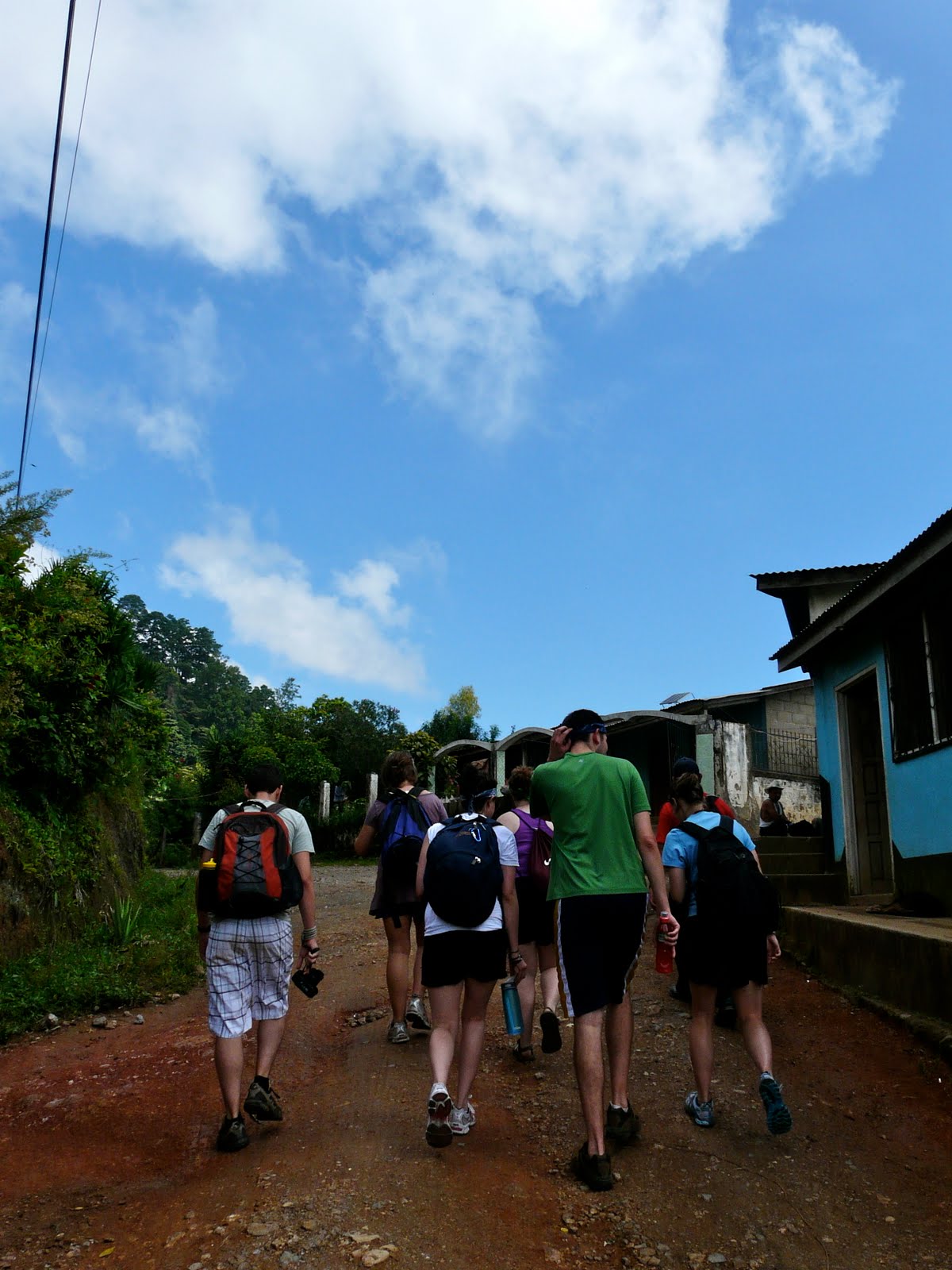
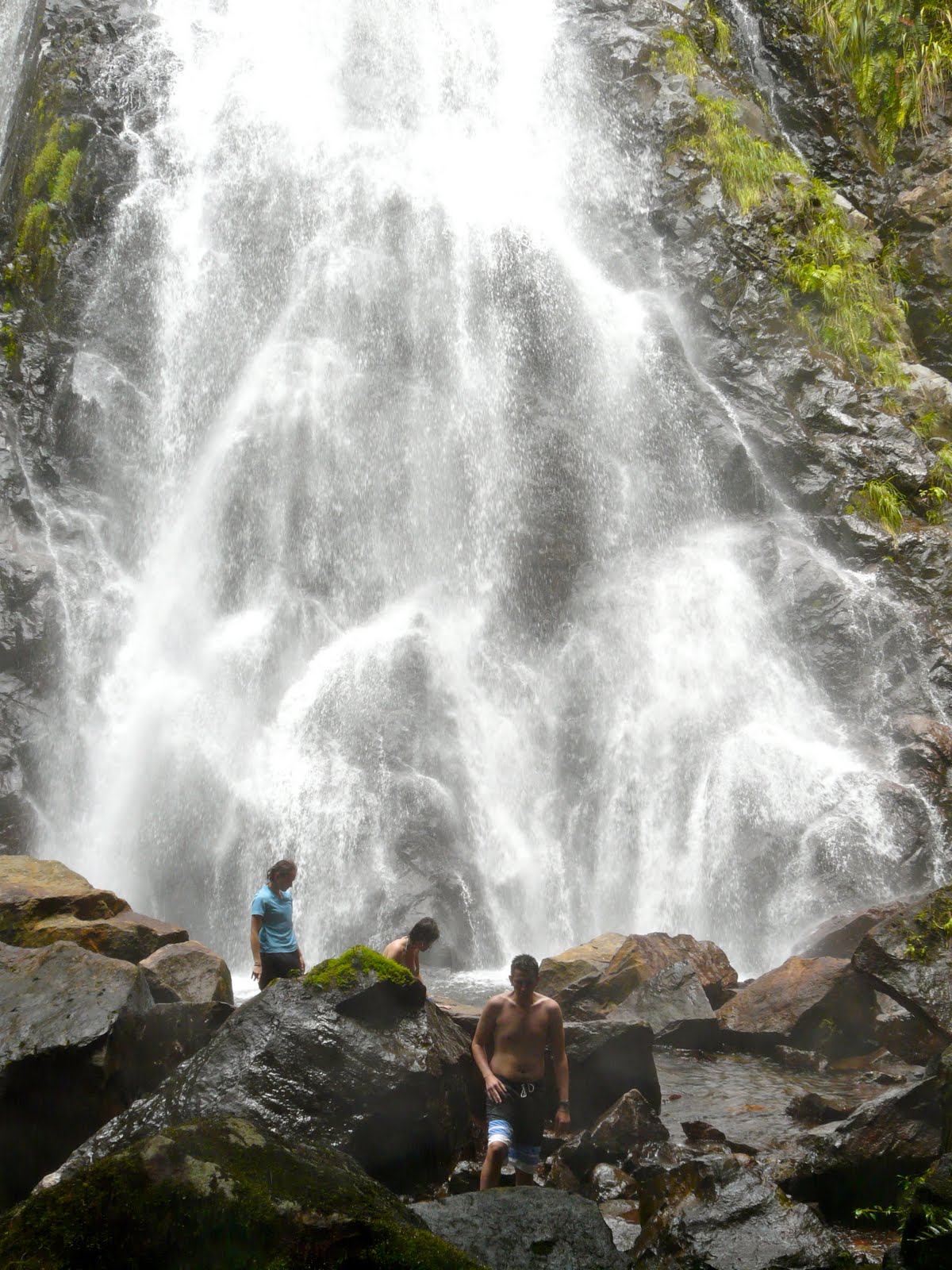
The next day we hiked through a coffee plantation with Ibis, the son of the plantation owner. Quiet and equipped with a machete, Ibis served as a guide for the three hour hike up to a massive waterfall on his father’s property for a small fee of $1 per person. At the end of our hike,  we jumped into the waterfall and the frigid mountain-stream water knocked the wind out of us. Relishing in the experience of  actually feeling cold for the first time in the month and half since I left California, I stood under the massive falls as they beat down on my back. For $35 that weekend, we got transportation, lodging, a machete-clad guide, three meals and two-nights worth of rum. Not a bad weekend.